
In engineering practice, many professionals still rely on well-established mix design methods—such as the ACI or ABCP methods—to define the initial concrete mix. However, it is important to understand that these methods provide only a starting point, essentially an “initial guess.”
That is precisely why trial batching becomes indispensable. Only through it is it possible to practically verify whether the concrete meets the fundamental requirements of cohesion, consistency, and strength. Without this fine-tuning, the risk of mix errors increases—potentially resulting in slump values outside the specified range, insufficient strength, and unnecessary increases in the cost per cubic meter of concrete.
It is in this context that Dosart PRO stands out. The system was developed to simplify and provide full control over the mix design process, allowing users to intuitively adjust the parameters that truly influence concrete behavior. With it, you can modify the mix during the trial batching phase and clearly visualize how these changes affect the final outcome.
In practice, this means moving away from a trial-and-error-based process toward a much more precise, fast, and reliable approach. The user gains autonomy to adjust the mix, optimize material consumption, and achieve the desired performance with much greater confidence—whether in the laboratory or directly on-site.
With the support of specialized software, concrete mix design is no longer a complex and uncertain process, but rather a controlled, predictable, and highly efficient step.
Using Dosart PRO for Concrete Mix Design
Dosart PRO was developed to transform a traditionally trial-and-error-based process into a structured, practical, and highly controllable workflow. Below, you’ll understand how to use the system in four fundamental steps—from curve definition to final mix validation.
1. Abrams Curve
The first step is defining the Abrams Curve, which establishes the relationship between the water-cement ratio (w/c) and the concrete strength.
In Dosart PRO, the user can:
- Select predefined curves, such as:
- A curve based on the ACI method
- A curve adjusted for CP II F 32 cement
- Or input their own curve, based on previously obtained experimental data
This flexibility allows the system to be adapted to the reality of the materials available on-site or in the laboratory, significantly increasing the accuracy of strength predictions.
2. Initial Mix
With the curve defined, the system proceeds to generate the initial mix.
This step is based on the ACI method, with practical adaptations that make the results more compatible with real field conditions. The user must provide:
- Material characteristics (cement, aggregates, etc.)
- Desired concrete properties (strength, workability, etc.)
Based on this data, Dosart PRO generates an estimated initial mix, which serves as the starting point for the trial batching process.
⚠️ It is important to note: this mix is not yet final—it must be validated and adjusted in practice.
3. Mix Adjustment (Trial Batching)
This is the most important stage of the process.
During trial batching, the user can adjust the initial mix based on the actual behavior of the concrete, aiming to meet the following requirements:
- Cohesion
- Consistency (slump)
- Strength
This is where Dosart PRO truly stands out: the system clearly and practically indicates which materials should be added to the mixture already in the mixer to transform the initial mix into the ideal one.
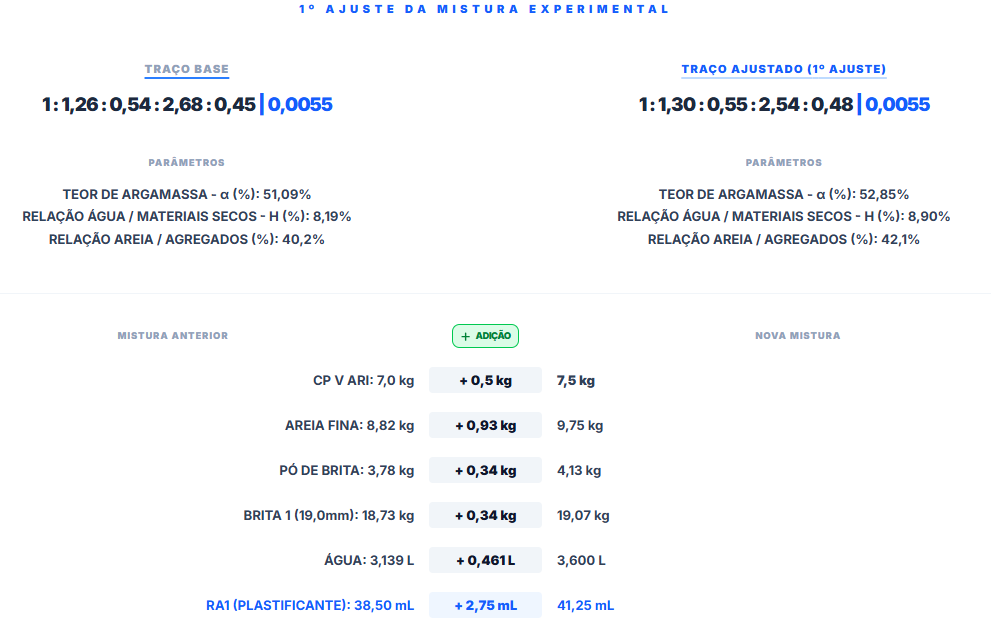
The adjustment can be carried out in two ways:
🔧 Manual Adjustment
The user directly controls the key parameters:
- Mortar content → influences cohesion
- Water-to-dry materials ratio → controls consistency (workability/flow)
- Water-cement ratio (w/c) → directly impacts strength
⚙️ Automatic Adjustment
The system applies predefined adjustments to quickly correct the properties of the concrete in its fresh state.
This approach eliminates guesswork and enables technically guided decisions, reducing waste and rework.
At the end of this stage, the user defines and saves the ideal adjusted mix.
4. Save and Validate the Mix
In the final step, the user can manage all developed mixes within the system.
On the saved mixes page, it is possible to:
- Organize the trial batches performed
- Record the results of compressive strength tests
- Validate, based on real data, the performance of the designed concrete
With this, the process is completed end-to-end: from the theoretical mix to practical validation, ensuring full control, traceability, and continuous improvement of results.
With this workflow, Dosart PRO transforms concrete mix design into a more precise, reliable, and efficient process—intelligently connecting theory and practice.
Additional Tools
Fine Aggregate Gradation Correction
Dosart PRO also includes a tool for fine aggregate gradation correction, which is essential for improving concrete quality.
The user inputs the sieve analysis data of two fine aggregates, and the system calculates the optimal blending proportion between them, aiming to fit the resulting gradation curve within the limits specified by Brazilian standards.
As a result, it is possible to achieve a more suitable particle size distribution, leading to:
- Improved workability
- Greater cohesion
- Reduced water and cement consumption
In practice, this tool enables quick and efficient aggregate adjustments, directly contributing to more economical concrete with better performance.
Estimation of Concrete Strength Development
Dosart PRO also offers a tool to estimate the development of concrete strength over time.
This feature is especially useful for evaluating whether results obtained at early ages (such as 3, 7, or 14 days) are consistent with the expected 28-day strength.
Based on the mix data, the system estimates strength evolution and allows the user to:
- Compare actual results with predicted values
- Identify performance deviations at early ages
If the results are significantly below expectations, it is possible to anticipate concrete redesign without waiting for the 28-day results, optimizing the mix more quickly and efficiently.
In practice, this reduces decision-making time and prevents the repetition of errors, ensuring greater control over concrete performance.
Conclusion
Concrete mix design no longer needs to be a trial-and-error process. With the use of the right system, it is possible to transform a complex activity into a controlled, predictable, and highly efficient workflow—ensuring more accurate mixes, material savings, and improved concrete performance.
Dosart PRO was developed with exactly this purpose: to simplify mix design, facilitate practical mix adjustments, and provide full control to the user—from initial definition to final on-site validation.
If you want to eliminate mix errors, optimize your results, and gain greater confidence in your designs, it’s time to evolve your process.
👉 Discover Dosart PRO and start designing concrete with much more precision, speed, and confidence.